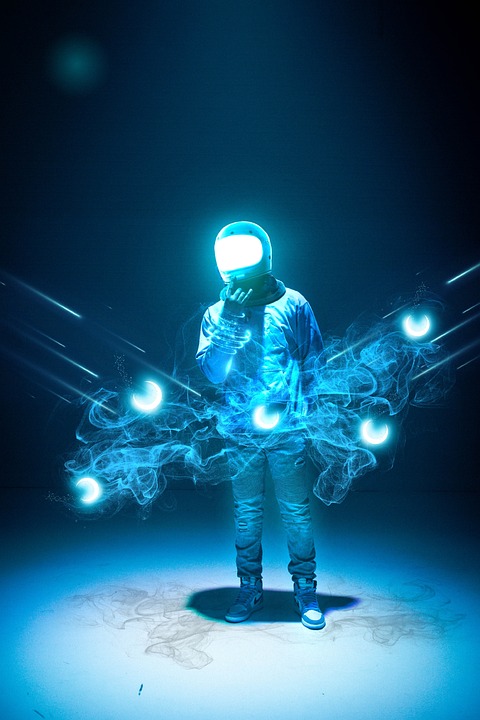
Digital Dreams: The Stunning Works of Art Being Created with AI and Machine Learning
The art world has always been a realm of human creativity and expression, with artists pushing the boundaries of what is possible with each new generation. But what happens when the creator is not human? The emergence of artificial intelligence (AI) and machine learning (ML) has opened up new possibilities for art, allowing machines to generate stunning works that are not only visually striking but also challenge our understanding of creativity itself.
In recent years, AI-generated art has been making waves in the art world, with works created using algorithms and neural networks selling for tens of thousands of dollars at auction. But the real value of AI art lies not in its commercial potential, but in its ability to expand our definition of creativity and challenge our assumptions about what it means to be an artist.
The Technology Behind AI Art
So, how does AI art work? The process typically involves feeding a machine learning algorithm a large dataset of images, which it uses to learn patterns and relationships between different visual elements. The algorithm can then generate new images based on this learning, often with surprising and innovative results.
One popular technique used in AI art is generative adversarial networks (GANs), which involve two neural networks working together to generate new images. One network, the generator, creates images, while the other, the discriminator, tries to distinguish between real and generated images. Through this process, the generator improves its ability to create realistic images, while the discriminator becomes better at detecting fake ones.
The Artists of AI
While AI art is often associated with machines, there are many human artists who are working with AI to create stunning works of art. These artists, often referred to as “AI artists,” use algorithms and machine learning techniques to generate images, but also bring their own creative vision and intuition to the process.
One example is the artist Refik Anadol, who uses AI to generate large-scale installations that explore the relationship between data and art. His work, “Melting Memories,” used EEG recordings of human brain activity to generate a stunning visualization of the human brain in action.
Another example is the artist Anna Ridler, who uses AI to generate intricate, dreamlike landscapes that explore the relationship between nature and technology. Her work, “Mosaic Virus,” used a GAN to generate a series of images that resembled the patterns found in nature, but with a strange, otherworldly twist.
The Future of Art
As AI and machine learning continue to evolve, it’s likely that we’ll see even more innovative and surprising works of art emerge. But what does this mean for the future of art? Will AI replace human artists, or will it augment their creativity and open up new possibilities for expression?
According to many experts, the answer is the latter. AI art is not a replacement for human creativity, but rather a new tool that can be used to explore new ideas and push the boundaries of what is possible.
“AI art is not about replacing human artists, but about augmenting their creativity and giving them new tools to work with,” says Dr. Jon McCormack, a researcher in AI and art at Monash University. “The best AI art is that which is created in collaboration with humans, where the machine is used to generate new ideas and possibilities that can be refined and developed by the artist.”
Conclusion
The stunning works of art being created with AI and machine learning are a testament to the power of human creativity and innovation. Whether used to generate intricate landscapes, explore the human brain, or push the boundaries of what is possible, AI art is a new frontier that is challenging our understanding of creativity and art itself.
As we look to the future, it’s clear that AI art will continue to play an important role in the art world, not as a replacement for human artists, but as a new tool that can be used to explore new ideas and push the boundaries of what is possible. Whether you’re an artist, a technologist, or simply someone who loves art, the digital dreams being created with AI and machine learning are sure to inspire and delight.